
Work-Integrated Learning Mentorship Guide


Welcome to the Work Integrated (WIL) Mentorship Guide. Whether you are a mentor, supervisor, or student (mentee) entering a placement, your role and presence are essential in shaping meaningful learning experiences. This guide offers a general framework for mentoring within WIL contexts, but it isn’t a one‑size‑fits‑all approach. Consider these ideas a foundation to build from. Feel free to adapt the tools, language, and strategies to fit your role, organizational context, and the unique dynamics of your mentoring relationship. WIL brings students into real‑world environments where tasks, relationships, and reflection come together. Because students have limited time to orient themselves, a mentorship mindset grounded in curiosity, strength-based support, and shared learning, can significantly enrich the experience for everyone involved.
This guide offers practical tools, principles, and strategies to help WIL supervisors and their placement students use a mentoring mindset to build strong relationships, navigate challenges, and support personal, academic, and career development. With this approach to supervision, students quickly build confidence and capacity, allowing them to make a significant impact while reducing the time and effort required from supervisors.
This guide was co-created by Mentor Canada, the Experiential Learning Hub at Queen’s University, and Queen’s Learning in Evaluation and Applied Research Networks (QLEARN). The project has been funded in part by the Government of Canada’s Innovative Work-Integrated Learning Program and CEWIL Canada’s iHub.
We invite you to approach this work with openness, humility, and a commitment to mutual learning.
Objectives
- Understand the purpose and mindset of mentoring.
- Recognize the roles and responsibilities of mentors and mentees.
- Apply concepts of mentoring in work-integrated learning.
- Identify and navigate common mentoring challenges.
Mentorship in Work-Integrated Learning (WIL) Opportunities
WIL opportunities – whether internships, co-ops, clinical or professional practicums, or community-engaged projects – are unique because they combine workplace responsibilities with intentional learning objectives. In these settings, supervisors often play a dual role by guiding students’ day-to-day work and accountability, while also supporting their personal and professional growth through ongoing conversation, feedback, and reflection. In WIL environments, students benefit from structured opportunities to try new tasks, reflect on their successes and challenges, and then apply what they’ve learned. As they navigate authentic work or community-based environments, a mentorship mindset can foster deeper learning from experience, opening more avenues for students to connect their work to personal values, social and cultural contexts, and their emerging sense of professional identity. Supervising with a mentorship mindset helps supervisors set expectations early while also supporting student independence – this leads to increased student engagement in their role, allowing them to ask better questions, apply their skills and knowledge in unique and creative ways, and ultimately leads to greater impact for the organization in a shorter period of time.
To learn more about WIL pedagogy see:
Access the Higher Education Quality Council of Ontario here.
WIL Quality Indicators, CEWIL Canada Resource Hub here.
Community-Engaged Teaching and Learning Framework
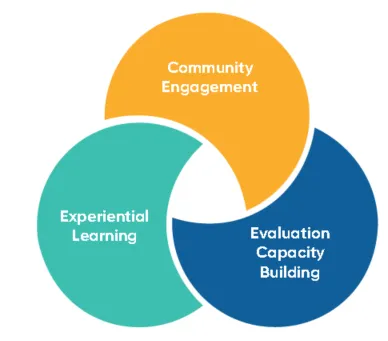
Secondary institutions and local, regional, national, and global communities. Because collaboration and reciprocal relationship building is a core element of community-engaged learning, it has much in common with the mentorship guidance provided throughout this guide. Through projects or placements, students collaborate with community partners to identify initiatives, co-create goals, and work towards mutually beneficial outcomes. Similarly, mentorship is fundamentally a learning relationship. Whether the audience is students, new hires, organizational leaders, volunteers, or community partners, the purpose of mentorship is growth; building capability, confidence, and connection. Bringing in concepts from learning theory and pedagogy strengthens mentorship by making that growth intentional rather than accidental.
WIL opportunities – whether internships, co-ops, clinical or professional practicums, or community-engaged projects – are unique because they combine workplace responsibilities with intentional learning objectives. In these settings, supervisors often play a dual role by guiding students’ day-to-day work and accountability, while also supporting their personal and professional growth through ongoing conversation, feedback, and reflection. In WIL environments, students benefit from structured opportunities to try new tasks, reflect on their successes and challenges, and then apply what they’ve learned. As they navigate authentic work or community-based environments, a mentorship mindset can foster deeper learning from experience, opening more avenues for students to connect their work to personal values, social and cultural contexts, and their emerging sense of professional identity. Supervising with a mentorship mindset helps supervisors set expectations early while also supporting student independence – this leads to increased student engagement in their role, allowing them to ask better questions, apply their skills and knowledge in unique and creative ways, and ultimately leads to greater impact for the organization in a shorter period of time.
Community-Engaged Pedagogy (CEP)
- Reciprocity – mutual benefit
- Ask yourself what does “success” or “growth” look like for everyone involved, not just me?
- Co-creation and shared power – shared ownership, collaborative development, respect for lived experience and local knowledge of all involved (both students and partners).
- E.g., insights and experience as valid evidence
- Consider non-western/academic ways of knowing to explore concepts, learning and relationship building
- Explicit reference and consideration for the commitment and contributions of everyone involved (and encouraging these contributions as part of the mentorship process)
- E.g., shared decision-making and recognition on formal and informal outputs + following/ respecting community guidance on treatment, security, and dissemination of knowledge
- Relationship and Trust-Building – focusing first and foremost on developing a shared understanding of collaboration, learning and mentorship. Investing time, care and attention to building relationships between partners/ interest holders.
- Regular check-ins and meetings not just for progressing work or compiling tasks
- Following-up on formal and informal items and providing meaningful feedback/ support or asking clarifying questions to better understand the perspective and reasoning of a mentor/mentee’s actions
- Critical Self Reflection – ongoing reflection on one’s own biases, personal assumptions and beliefs, especially in relation to power and privilege and how it might impact collaboration and partnership actions (especially when there is the additional mentor/mentee dynamic.
- E.g., regularly embed reflection/ sense-making conversations into workflow
- Consider opportunities to explore positionality early on in the process (depending on comfort level of co-learners)
- Asset-Based / Strengths-based approach – starting from an assumption of strength, capability, and resilience, focusing on what is already present (tangible and intangible) rather than a deficit perspective.
- Again, for both the student/ mentee and partner/ mentor (or vice versa)
- E.g., avoid focusing on gap analysis or problems first – focus on mentorship goals and current assets to support those goals
- Frame collaborative work and learning and expanding upon, deepening, or amplifying existing services, opportunities or actions
- Sustainability – specifically sustainability of partnerships and participating in engagement and mentorship with a long-term vision in mind to cultivate and maintain positive relationships, capacity-building and short, medium, AND long term co-learning outcomes.
- Consider the uptake/ use of the learning and mentorship beyond this specific engagement
To learn more about community-engaged learning check out the following resources:
Queen’s University Community-Engagement Framework here.
CEWIL Community Service-Learning Faculty Toolkit here.
For example, The Community-Engaged Teaching and Learning Framework at Queen’s University emphasizes collaboration between students, faculty, and community partners to create meaningful, real-world learning experiences. Through initiatives like QLEARN, students apply research and evaluation skills in partnership with organizations, addressing complex social challenges while advancing academic and professional growth. This approach integrates teaching, research, and community engagement into a shared process of co-learning; fostering relationships, building capacity, and contributing to positive social change.
How to Use this Guide
We recommend progressing through each part in order. Each section builds on the last, guiding you from the foundations of mentorship to practical implementation, navigating challenges, and additional resources to deepen your mentoring practice.

Part 1: Building a Strong Foundation
Explore the foundations of effective mentoring, including mentoring mindsets, principles, roles and responsibilities, and different approaches to mentoring.

Part 2: Implementation Guide
Learn practical strategies for starting strong, building trust, setting goals, and supporting student growth throughout the mentoring relationship.

Part 3: Navigating Challenges and Sustaining Relationships
Discover strategies for addressing common mentoring challenges, maintaining healthy boundaries, repairing relationships, and supporting transitions.

Part 4: Reflection Activities and Practical Tools
Access worksheets, reflection activities, tools, and additional resources to support and deepen mentoring practice.